Thought Leadership · Research Commercialisation
From Citations to Commercialisation: Why India's Research Rankings Need a Reality Check
Dr Manish Malhotra
Founder and CEO, Futred Innovation Studios
Recent headlines around global university rankings have sparked an uncomfortable but necessary conversation: Are we measuring research excellence, or just learning how to game algorithms?
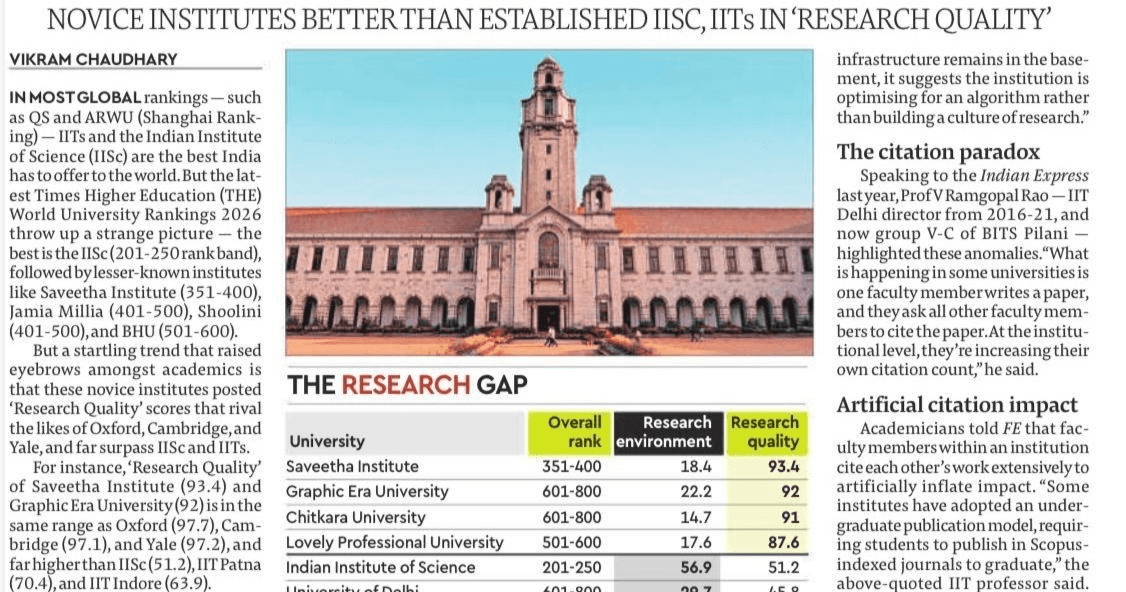
A recent Times Higher Education rankings analysis shows several young private universities in India scoring higher than IISc and IITs on "Research Quality", despite having far weaker research ecosystems. The explanation points to concentrated citation practices, internal cross-citation, and mandatory publication models that optimise for ranking metrics rather than genuine research impact.
This exposes a deeper issue: Research is being measured by how often it is cited — not by how much it changes the world.
The Missing Metric: Technology Transfer and Commercialisation
Globally, the most respected research universities do not define success by papers alone. They define it by outcomes such as startups created, patents licensed, industry adoption, revenue from technology transfer, jobs created from research, and societal impact.
In other words: Knowledge → Innovation → Enterprise → Impact. This is the gold standard Futred Innovation Studios believes India must adopt.
Proven Global Models That Work
The University of Queensland (Australia)
The University of Queensland (UQ) is one of the world's most successful commercialisation universities. Through UQ Ventures, it has created more than 120 spinout companies and generated billions of dollars in commercial value. These ventures span vaccines, biotechnology, mining technology, artificial intelligence and sustainability solutions, in partnership with global companies such as CSL and Boeing. Their research is not only published — it is productised and deployed in real markets.
Stanford University (USA)
Stanford's Office of Technology Licensing has produced some of the world's most influential technology companies including Google, Cisco and Sun Microsystems. Stanford measures research success through startup formation, licensing income, industry collaboration, and global societal impact. Research at Stanford is deliberately designed to move from lab to market.
MIT (USA)
MIT has built perhaps the most powerful university innovation ecosystem in the world. Over 30,000 companies globally trace their origins to MIT research and alumni. These companies generate revenues comparable to the GDP of many nations. MIT's model is built on a continuous pipeline of laboratory research, prototype development, venture formation and market deployment.
Oxford University (UK)
Oxford University Innovation has created more than 300 spinout companies and generated hundreds of millions of pounds in licensing revenue. Its research commercialisation model has become one of Europe's strongest engines for health technology, artificial intelligence and scientific enterprise.
The Indian Challenge
In India, research incentives remain skewed toward publication volume rather than innovation outcomes. Faculty members are rewarded for the number of papers produced. Students are often required to publish to graduate. Citations inflate institutional rankings while industry linkage remains weak. Intellectual property creation is rare and technology transfer offices are underdeveloped.
This results in paper factories instead of innovation engines.
India does not need more publications. India needs more research ventures.
Futred's Vision: Research Commercialisation for Real Impact
At Futred, true research excellence must be measured by its ability to become a product, form a startup, solve industry problems, generate intellectual property, create revenue and produce employment.
Futred's Research Commercialisation vertical focuses on:
- Industry-linked research programs
- Innovation studios inside universities
- Startup formation from faculty and student research
- Global mentorship from Australia and the United Kingdom
- Intellectual property creation and venture building
- Technology transfer frameworks aligned with global best practice
Futred is building India's bridge from research to enterprise.
A New Ranking Philosophy for India
Imagine a ranking system that rewards:
- Startups created per university
- Licensing revenue
- Patents commercialised
- Industry adoption
- Employment generated
- Global collaborations
Such a ranking system would reflect real-world impact rather than algorithmic optimisation.
The Future of Indian Research
India has world-class intellectual capital. What it lacks is structured commercialisation infrastructure. The next phase of Indian higher education must move from citations to creations, from papers to products and from rankings to real impact.
True research excellence is not how often your work is cited. It is how many lives it improves.