Manoj U. · BCA, Shree Vedha College (Bangalore University) — PitchX Programme
E-Hub — How Can a Smart Hub Solve India's EV Charging Bottleneck?
Summary
Methods
Disciplinary perspectives
India's transportation sector is shifting rapidly toward electric vehicles, but charging infrastructure has not kept pace — leaving EV users with limited stations, long waits, and few nearby services. This project proposes E-Hub, a smart electric vehicle charging and service center that combines fast charging, maintenance, digital payments, real-time charger availability, and customer amenities in a single location.
By integrating renewable energy sources such as solar power with modern charging technology, E-Hub is designed to make EV charging more convenient, reliable, and sustainable — supporting clean transportation and a future-ready charging ecosystem.
Approach and Methodology
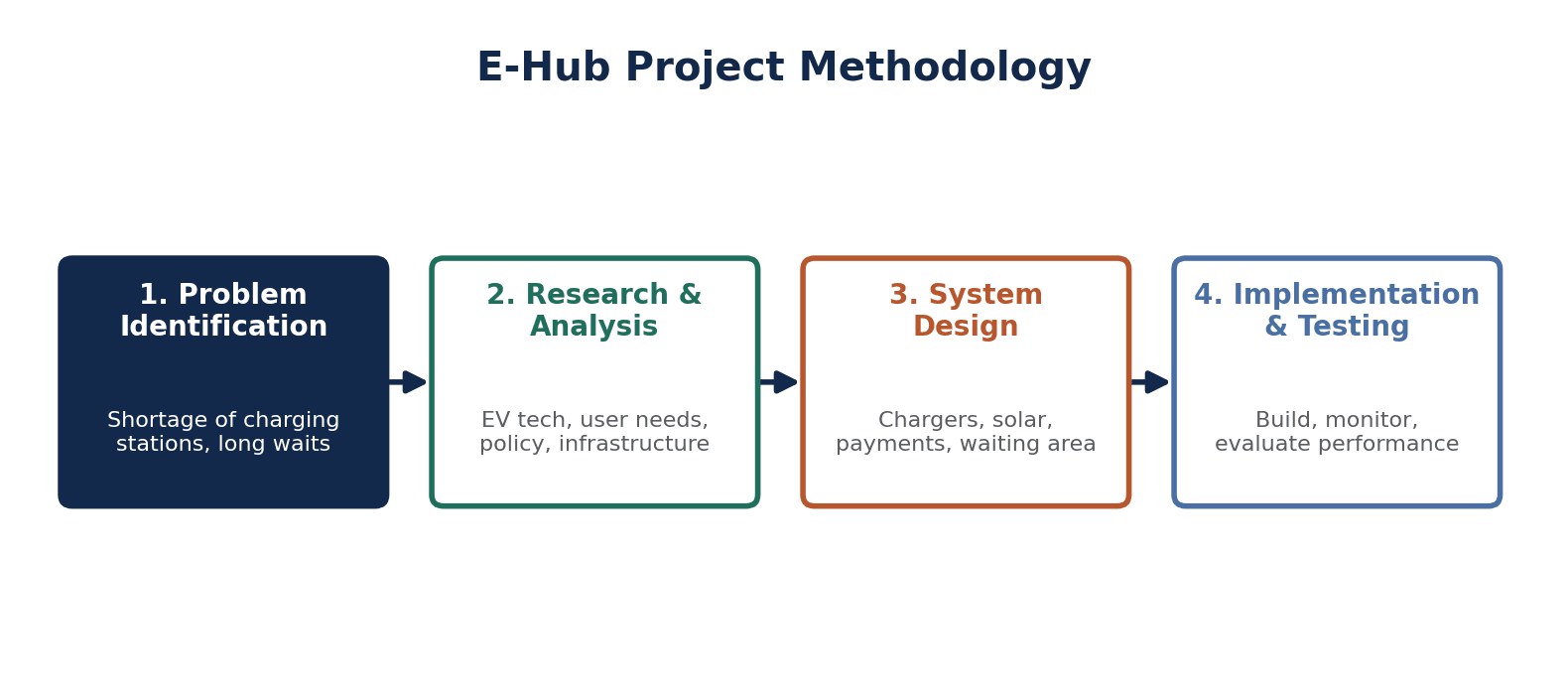
The project followed a four-stage methodology. It began with problem identification: studying the increasing number of electric vehicles on Indian roads and pinpointing the shortage of charging stations, long waiting times, and lack of customer facilities as the core bottleneck.
This was followed by research and analysis, gathering information on EV charging technology, user requirements, government policy, and existing charging infrastructure, and system design, in which the E-Hub itself was laid out with fast and slow charging stations, solar power integration, battery backup, an EV service area, a digital payment system, and customer waiting facilities.
The final stages were implementation — developing the E-Hub model by integrating charging equipment, smart monitoring, online booking, and real-time charger availability — and testing and evaluation, assessing the system against charging efficiency, user convenience, reliability, energy consumption, and customer satisfaction.
Proposal / Outcome
The resulting E-Hub concept centres on a central management system that connects chargers from different brands, the utility grid, renewable energy sources, and billing and monitoring dashboards, so that supply and demand across the site can be balanced automatically. For drivers, the experience is designed around a simple app flow: download the app, sign up, add a payment method, find the nearest station, plug in, scan a QR code, and receive real-time charging updates.
The physical site design places fast and slow chargers under a solar canopy alongside a dedicated waiting area and office space, with a companion floor plan showing how vehicle flow, charging bays, and pedestrian areas can share the same footprint safely.
The model reduces charging wait times through real-time slot booking and improves user convenience by offering multiple services at a single location. Solar integration lowers electricity costs and supports environmentally friendly operations, while a waiting lounge, Wi-Fi, refreshments, and EV maintenance services round out the customer experience.
Beyond Outcomes
The wider analysis behind E-Hub is that the rapid growth of electric vehicles has created strong demand for reliable, accessible charging infrastructure, and that existing stations are too few and too disconnected to meet it. By bringing smart charging technology, renewable energy, digital booking, and customer facilities into one service center, the project argues that charging efficiency and user experience can improve together, rather than being traded off against each other.
Looking forward, the project frames E-Hub as one building block in a larger clean-mobility ecosystem: with further advancement and expansion, this kind of hub could become a standard piece of infrastructure supporting India's shift toward sustainable transportation and reduced carbon emissions.
About me
Manoj U.
BCA, Shree Vedha College (Bangalore University)
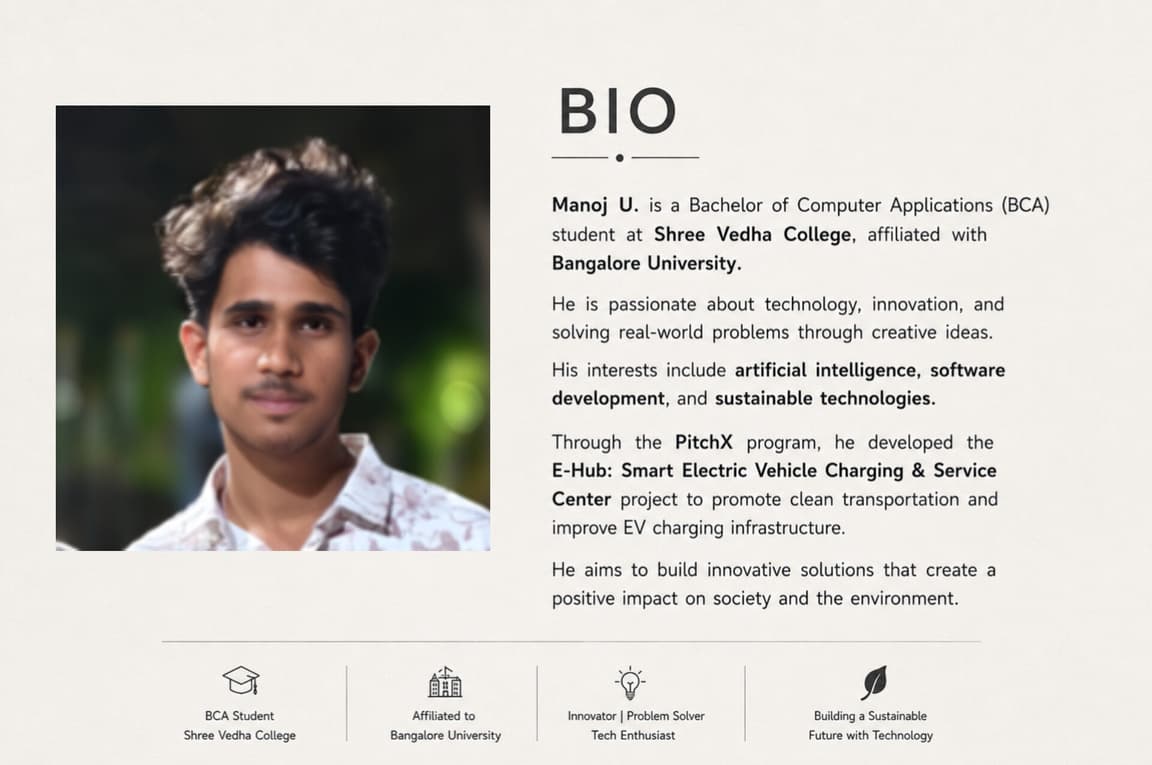
Manoj U. is a Bachelor of Computer Applications (BCA) student at Shree Vedha College, affiliated with Bangalore University. He is passionate about technology, innovation, and solving real-world problems through creative ideas, with particular interests in artificial intelligence, software development, and sustainable technologies. Through the PitchX programme, he developed the E-Hub: Smart Electric Vehicle Charging & Service Center project to promote clean transportation and improve EV charging infrastructure. He aims to build innovative solutions that create a positive impact on society and the environment.
Other Related Projects
← Back to the repository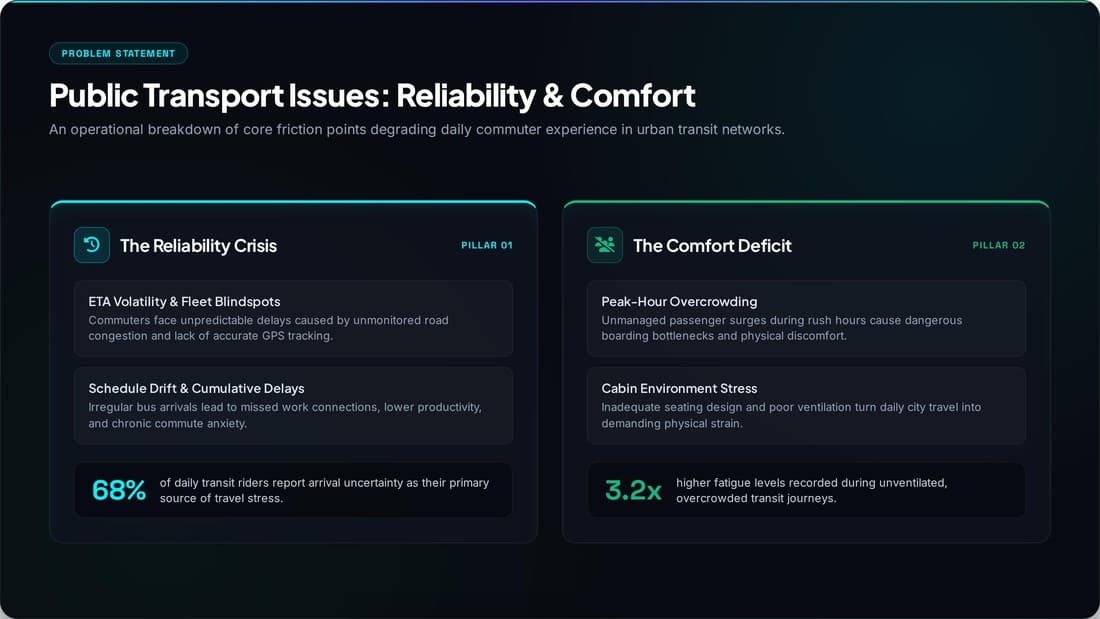
TransitPulse — Can Smart Sensors and Predictive Routing Fix Public Transport's Reliability and Comfort Problems?
This project breaks down daily public transport frustration into two linked problems: a reliability crisis, where riders can't trust when a bus will actually arrive, and a comfort deficit, where the ride itself is overcrowded and physically demanding. It then proposes an Integrated Smart Mobility Framework — a three-part technology system designed to make fleets more predictable and journeys more comfortable at the same time. The case for action is backed by two figures from the research: 68% of daily transit riders report arrival uncertainty as their primary source of travel stress, and commuters record 3.2× higher fatigue levels on unventilated, overcrowded journeys.
#Mobility#Technology#Urban Design
AgriGuard — How Can a Smart Agriculture Support System Help Farmers Manage Unpredictable Weather?
Farmers depend heavily on the weather for cultivation, yet sudden rainfall, droughts, floods, and extreme temperatures regularly damage crops and cut into their income. This project, developed during the PitchX Programme, asks how a combination of storage infrastructure and digital support could help farmers absorb these shocks and manage their land more effectively. The proposed response is a Smart Agriculture Support System: low-cost warehouse facilities paired with weather alerts, irrigation guidance, market price information, training, and access to government schemes — addressing storage and information gaps side by side rather than treating them separately.
#Agriculture#Sustainability#Technology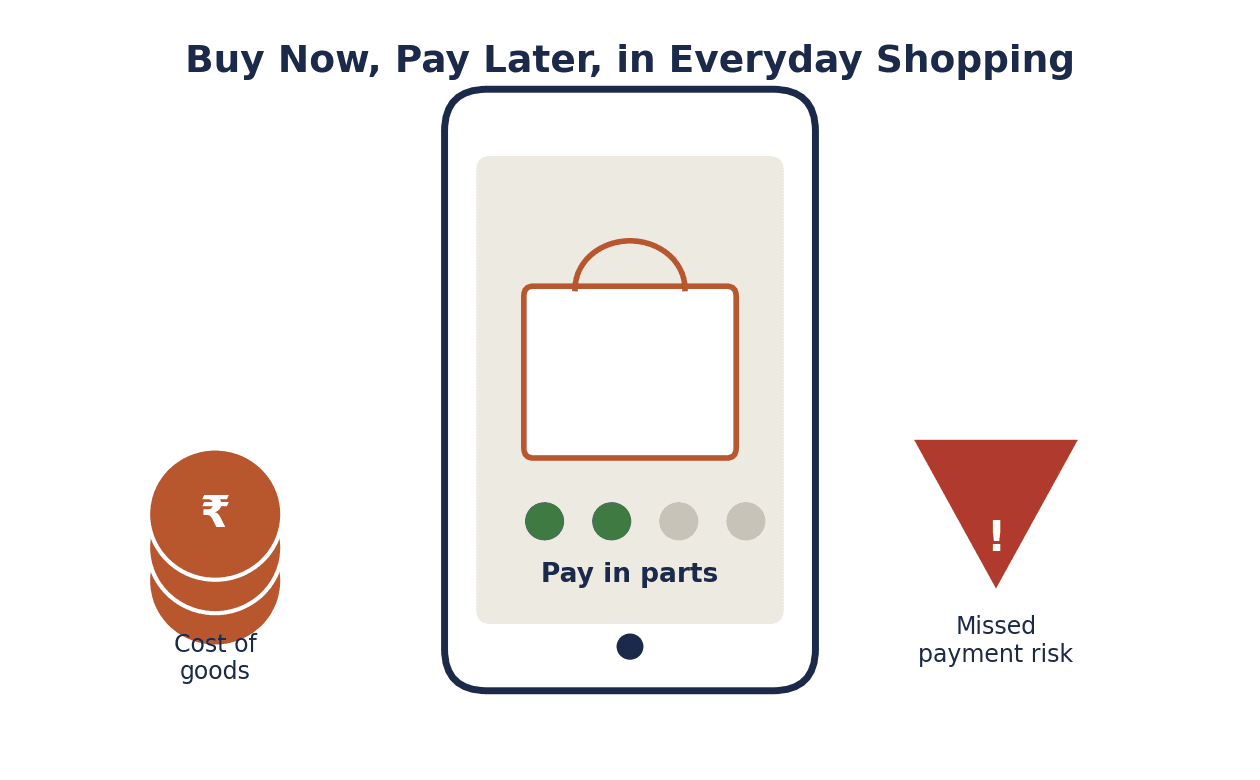
Does Buy Now, Pay Later Help or Hurt People's Money Habits?
Buy Now, Pay Later — usually called BNPL — lets people buy something today and pay for it in small parts later, often without any extra interest cost. It is very popular with people who shop online, because it makes things feel cheaper and easier to buy right away. But for some people, BNPL also brings worry about money and debt. This project asks a simple question: does BNPL really help people manage their money better, or does it quietly cause more financial stress than people realise? It looks at the feelings, habits, and real money outcomes of BNPL users together, instead of studying each one on its own.
#Finance#Consumer Behaviour#Digital Payments